
About VECSTAR™

What is Liquid Crystal Polymer (LCP)?
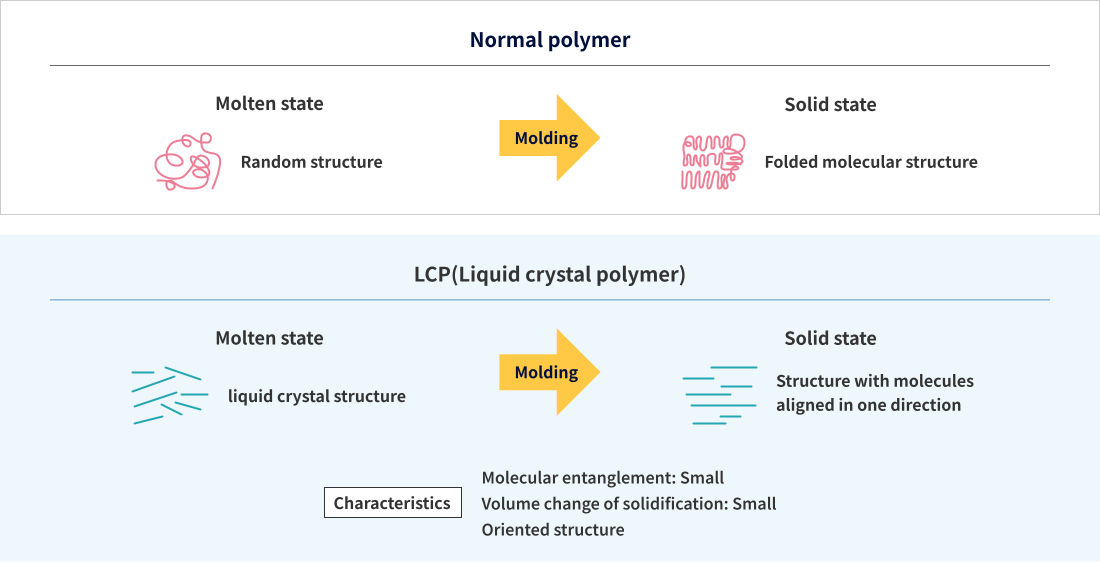
Liquid Crystal Polymer (LCP) is a class of thermoplastic synthetic resins characterized by highly ordered, linear molecular chains in the molten state. It is classified as a super engineering plastic.
LCP is widely used in a variety of applications, including base materials for printed circuits in electronic devices such as smartphones, tablets, and PCs, as well as automotive components. It is also used for precision injection-molded parts, including connectors and sockets.
Key Properties of LCP
LCP exhibits the following properties derived from its unique molecular structure:
- High flowability
- Excellent dimensional stability
- High rigidity
- Low coefficient of linear expansion
- Superior gas barrier performance
- Low water absorption
- Good vibration damping
What is VECSTAR™?
VECSTAR™ is Kuraray’s liquid crystal polymer (LCP) film, engineered using proprietary film-forming technology. It combines the inherent advantages of LCP with film-specific performance, making it particularly suitable for high-frequency electronic applications and advanced printed circuit materials.
Structure and Features of LCP
The exceptional performance of LCP is attributed to its molecular structure, in which rigid, rod-like polymer chains align in an ordered manner even in the molten state. This unique structure enables a combination of high mechanical strength, thermal stability, and excellent electrical performance, making LCP an ideal material for demanding applications.
Properties
Characteristics of VECSTAR™
Kuraray has developed VECSTAR™ LCP film as a base material for high-performance printed circuits using its proprietary film-forming technology.
This technology addresses the issue of variation in properties depending on film orientation, while fully retaining the inherent advantages of LCP.
VECSTAR™ offers a range of characteristics that help solve various customer challenges and enable advanced applications.
Key Performance Areas

Excellent high-frequency performance, supporting high-speed signal transmission.

Superior flexibility, enabling reliable performance in bending and dynamic applications.
High mechanical strength, contributing to durability and reliability.

Outstanding gas barrier performance, improving environmental resistance.

Excellent shape stability, maintaining performance under thermal and mechanical stress.

Processability
High suitability for processing, enabling efficient fabrication and design flexibility.
