
High-Performance Glass Antennas with VECSTAR™ Enabling Seamless Connectivity for Next-Generation Mobility and Infrastructure

Are you facing these challenges?
- Difficulty achieving stable 5G communication
- Trade-offs between antenna performance and product design
- Challenges in integrating antennas into glass structures
- Inefficient transmission of radio waves to antennas
- Limitations in increasing the number of antennas
Solution: High-Performance, Invisible Antennas Integrated into Glass
VECSTAR™ enables the development of compact, high-performance antennas that deliver stable communication—even when integrated into glass structures.
As communication frequencies increase and antenna density grows, seamless integration into automotive and architectural glass becomes essential. VECSTAR™ provides a solution that combines performance, flexibility, and design freedom.

Advanced Antenna Design with Low-Loss Materials
VECSTAR™ is a thermoplastic LCP film with a low dielectric constant, enabling the fabrication of fine, multilayer antenna structures.
This allows:
- High-performance antenna miniaturization
- Increased antenna density without design compromise
- Visually unobtrusive integration into glass
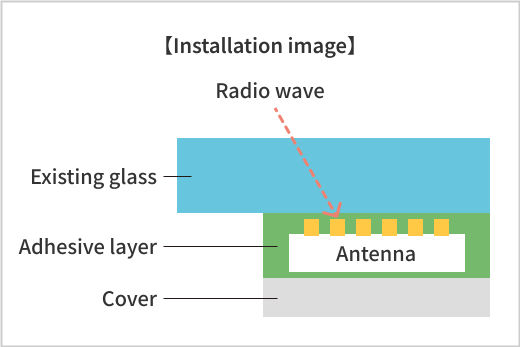
Efficient Signal Transmission Through Glass
When antennas are mounted on glass, signal loss and reflection can become critical issues.
VECSTAR™ helps:
- Suppress radio wave reflection within glass
- Improve transmission efficiency to the antenna
- Enable stable communication performance
This results in reliable connectivity, even in challenging installation conditions.

Flexible Integration for Advanced Designs
Thanks to its flexibility, VECSTAR™ can be applied along curved surfaces such as automotive windshields.
It also enables:
- Integration of antennas and cables into a single component
- Seamless, design-friendly installation in vehicles
- Enhanced aesthetic value without sacrificing performance
Key Features


Proven & Emerging Applications include:

5G communication systems

Emergency/disaster communication infrastructure

Autonomous driving systems
